
The top marketing automation software you choose can make or break your startup’s growth trajectory in 2026. About 76% of enterprises use some form of marketing automation technology, and the marketing automation sector is projected to reach $13.71 billion by 2030. Startups that utilize these platforms get faster feedback loops and can iterate marketing experiments in hours instead of weeks.
We’ve compiled our expert picks for the top marketing automation platforms that cover e-commerce marketing automation and sales alignment. This will help you find the top marketing automation software that fits your startup’s goals.
HubSpot Marketing Hub
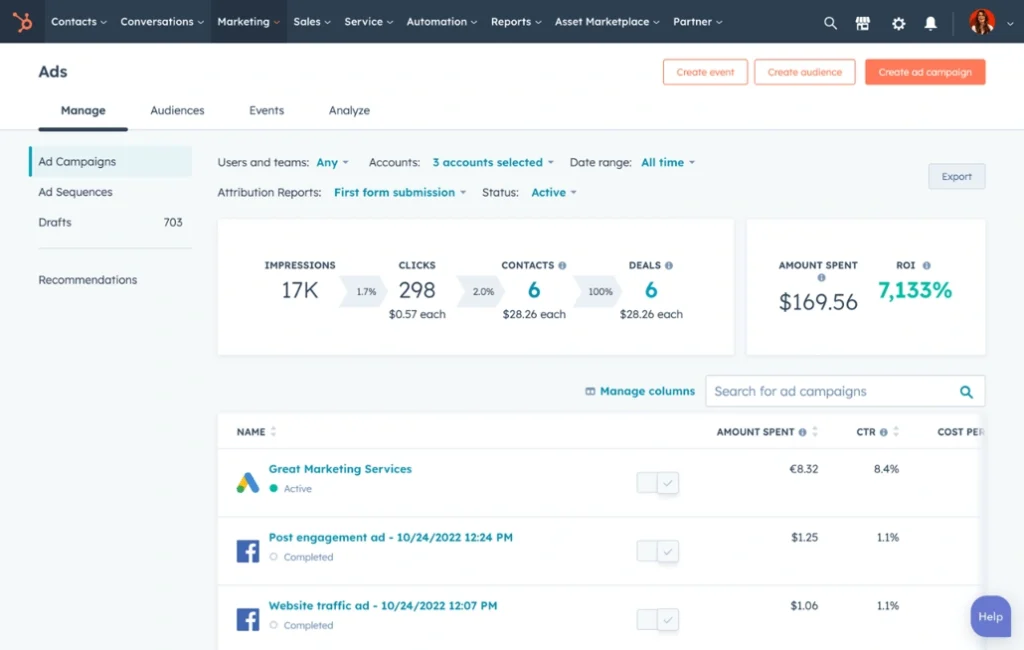
Image Source: HubSpot
HubSpot Marketing Hub stands out among top marketing automation platforms by integrating campaign automation, CRM, and email marketing into a single solution. The platform has proven effective, with 82% of marketers reporting increased lead generation. It eliminates the need to juggle multiple disconnected tools and gives startups enterprise-grade capabilities.
Key Features
The platform offers hundreds of customizable email templates with a drag-and-drop editor that requires no coding knowledge. You can build automation workflows using templates or a custom builder. This allows you to set up drip campaigns, trigger sequences based on subscriber actions, and combine emails with SMS and push notifications in the same workflow. The CRM integration enables powerful segmentation based on contact behavior, properties, and lifecycle stages.
Reporting tools give detailed insights into campaign performance in email marketing, blogging, and social media. The platform has SEO recommendations, content management capabilities, and landing page builders with conversion optimization tools. Smart Content personalization lets you display different copy and images based on list membership, region, or job title.
Pros and Cons
Pros:
- All-in-one platform with native CRM integration that gives a unified customer view
- Free plan has CRM, 2,000 email sends monthly, and social media integrations
- Scalable solution that grows from startup to enterprise without switching platforms
- Clean interface with proactive hints and guidance
- Strong automation capabilities with visual workflow builder
Cons:
- Professional and Enterprise plans require onboarding fees of USD 3,000.00 and USD 7,000.00 respectively
- Steep learning curve for advanced features and complex workflows
- Costs scale substantially with contact volume
- Some customization limitations for businesses with unique needs
- Multi-brand revenue attribution lacks proper segmentation
Best For Startups
HubSpot for Startups program gives eligible companies 50-90% discounts in the first year, with continued savings in years two and three. The program replaces multiple tools and saves startups USD 200.00-USD 300.00 monthly while centralizing sales, marketing, and customer data. The free plan offers a painless entry point for new businesses and has higher email sends than competitors like Mailchimp.
HubSpot Pricing
| Plan | Price | Marketing Contacts | Email Sends | Key Features | Setup Fee |
|---|---|---|---|---|---|
| Free | USD 0.00 | 100 contacts | 2,000/month | Basic CRM, forms, email marketing, live chat | None |
| Starter | USD 20.00/month/seat | 1,000 contacts | 5x contact tier limit | Remove branding, basic automation, ad management | None |
| Professional | USD 800.00/month | 2,000 contacts | 10x contact tier limit | Omni-channel automation, social media, A/B testing, custom reporting | USD 3,000.00 |
| Enterprise | USD 3,600.00/month | 10,000 contacts | 20x contact tier limit | Multi-touch attribution, customer journey analytics, advanced permissions | USD 7,000.00 |
Professional has 3 core seats with additional seats at USD 45.00/month, while Enterprise has 5 core seats with additional seats at USD 75.00/month.
ActiveCampaign
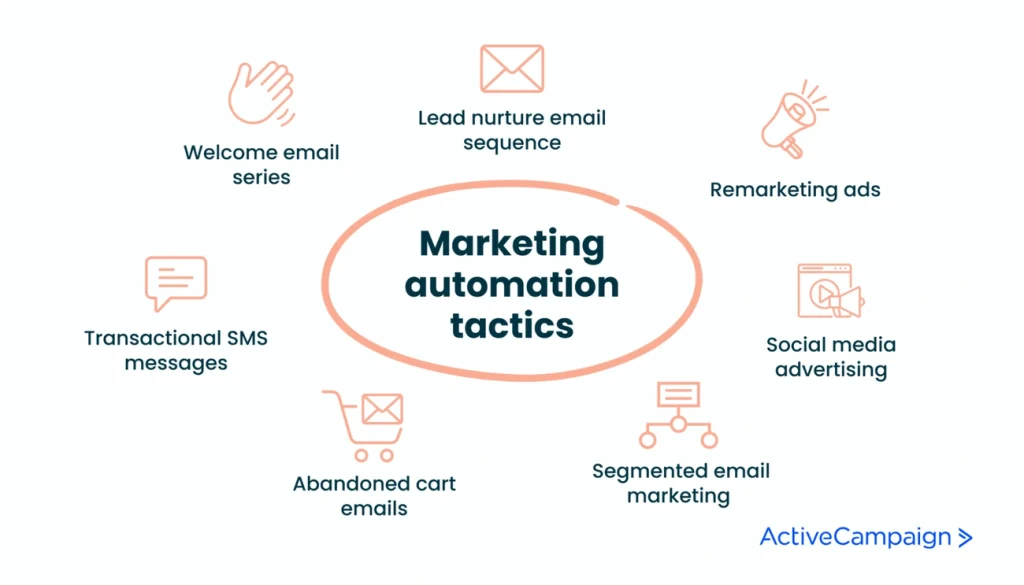
Image Source: ActiveCampaign
ActiveCampaign brings AI-powered automation to startups through its Active Intelligence platform, which arranges customer journeys across email, SMS, WhatsApp and web channels. Over 180,000 businesses in 170 countries use the platform, drawn especially to its automation builder that ranks among the most powerful tools you can get.
Key Features
The platform connects with over 1,000 apps and lets you integrate your entire tech stack naturally. Its automation builder offers 900+ pre-built workflow templates that you can customize using a visual drag-and-drop interface. You can create automated email campaigns triggered by specific customer actions, implement lead scoring to prioritize high-potential prospects and design personalized customer journey maps.
ActiveCampaign’s AI assists in automation building, content generation, segmentation, and campaign scheduling. The platform has landing page builders, customizable forms (inline, floating box, modal) and omnichannel marketing capabilities. Site tracking monitors every visitor interaction. The integrated CRM manages contacts and automates sales follow-ups. Email deliverability rates rank among the highest in the industry, with built-in spam testing and list warming features.
Pros and Cons
Pros:
- Automation builder with 135+ triggers and actions makes complex workflows manageable
- High email deliverability with extensive list cleansing tools
- 900+ integrations with deep connections to Salesforce and Shopify
- Free migration service from any email marketing or CRM platform
- AI-powered Active Intelligence optimizes campaigns and predicts customer behavior
Cons:
- Pricing scales faster with contact growth and reaches USD 339.00/month for 10,000 contacts on the Pro plan
- Simple CRM functionality lacks advanced features for complex sales teams
- 14-days free trial is shorter than competing platforms
- Recent policy change charges new customers for inactive contacts (unsubscribed, bounced, unconfirmed)
- Starter plan limits automations to 5 steps without conditional branching
Best For Startups
Qualified startups receive 90% off any ActiveCampaign annual plan for the first year. Pricing starts at USD 9.00/month. This makes the platform available for early-stage companies building their marketing infrastructure. ActiveCampaign works best for startups prioritizing marketing automation over simple newsletters and those needing ecommerce integrations with platforms like Shopify and WooCommerce.
ActiveCampaign Pricing
| Plan | Monthly Cost (1,000 contacts) | Users | Key Features | Email Send Limit |
|---|---|---|---|---|
| Starter | USD 15.00 | 1 | Email marketing, simple automation, 150+ templates | 10x contact limit |
| Plus | USD 49.00 | 3 | CRM, lead scoring, landing pages, generative AI | 10x contact limit |
| Professional | USD 79.00 | 5 | Predictive sending, attribution, split automation | 12x contact limit |
| Enterprise | USD 145.00 | 10 | Custom reporting, SSO, dedicated account rep | 15x contact limit |
Add-ons have CRM Pipelines (USD 68.00/month), SMS (USD 16.83/month with 1,000 credits), and Custom Reporting (USD 159.00/month). Additional users cost USD 12.00/month each.
Mailchimp
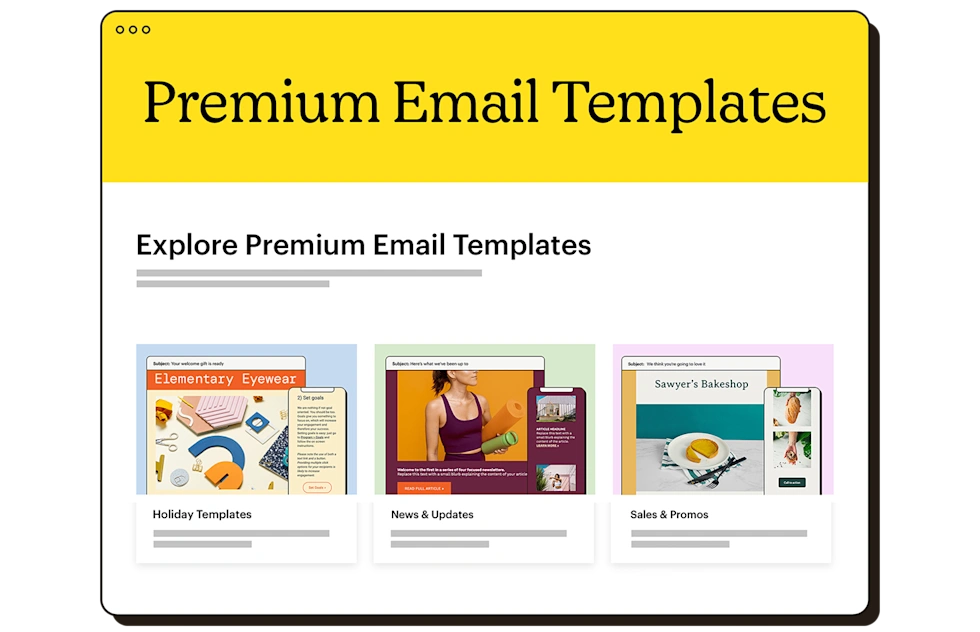
Image Source: Mailchimp
Mailchimp built its reputation as the go-to email marketing platform for small businesses, with over 14,000 people signing up daily. Acquired by Intuit for USD 12.00 billion in 2021, the platform has evolved into an all-in-one marketing solution. But recent changes to its pricing model and free plan have sparked debate about its value proposition for startups.
Key Features
The drag-and-drop email builder remains Mailchimp’s strongest asset and offers 260+ customizable templates. You can create campaigns without touching code. AI-powered tools generate copy and design elements. The Customer Journey Builder provides pre-built automation templates, though workflows are limited compared to dedicated automation platforms.
Mailchimp integrates with over 300 third-party applications, including Shopify, WooCommerce, and Stripe. The platform handles behavioral targeting, predictive demographics, and audience segmentation in multiple channels. You can create landing pages, social media ads, and transactional emails without leaving the dashboard.
Pros and Cons
Pros:
- Accessible interface with minimal learning curve
- 300+ native integrations covering most business tools
- AI features for email writing and design
- 14-day free trial on Essentials and Standard plans with no credit card required
Cons:
- Free plan reduced to just 250 contacts and 500 emails monthly
- Charges for unsubscribed and non-subscribed contacts unless archived manually
- Customer support rated 2.8 out of 5 on Trustpilot with 1,345 reviews
- Phone support is locked behind the USD 350.00/month Premium plan
- Automation and scheduling have been removed from the free tier
Best For Startups
Mailchimp suits brand-focused startups needing email, ads, and CRM in one place. The platform works well if you value polish and ease of use over advanced automation capabilities. For startups prioritizing integrations with existing tools, Mailchimp’s connection library makes onboarding smooth.
Mailchimp Pricing
| Plan | Price | Contacts | Monthly Sends | Key Limitations |
|---|---|---|---|---|
| Free | USD 0.00 | 250 | 500 (250/day) | No automation, no scheduling, 30-day support only |
| Essentials | USD 13.00 | 500 | 5,000 | Basic automation (4 steps max), 50k contact limit |
| Standard | USD 20.00 | 500 | 6,000 | Multi-step automation, 100k contact limit |
| Premium | USD 350.00 | 10,000 | 150,000 | Phone support, unlimited contacts |
Pricing scales with list growth. At 2,500 contacts, Essentials costs around USD 45.00 monthly.
Brevo (Sendinblue)
Image Source: PCMag
Brevo (formerly Sendinblue) separates itself among top marketing automation platforms through an email volume-based pricing model rather than charging per contact. With over 500,000 customers globally, the platform offers one of the most generous free plans available. You get 300 emails per day and up to 100,000 contacts.
Key Features
The platform bundles email marketing, SMS, WhatsApp campaigns, live chat, and a sales CRM under one roof. Brevo’s automation workflow designer triggers campaigns based on email engagement, webpage visits, and ecommerce activity. The AI assistant generates email content and optimizes send times. It also streamlines customer support with chat summaries. These AI features feel more extensive and practical than many competitors.
Brevo’s SMTP relay service delivers transactional emails with remarkable speed: 50% within 1 second and 99.98% within 20 seconds. The platform has 47 responsive email templates sorted by purpose rather than industry. The free plan comes with a built-in sales CRM that has visual pipelines and automated task generation.
Pros and Cons
Pros:
- Plans starting at USD 9.00 for 5,000 emails make it 72% cheaper than Mailchimp
- Unlimited contacts on most tiers without price spikes
- Advanced workflow automation has lead scoring and web tracking on the free plan
- Transactional email and multi-channel messaging (SMS, WhatsApp) are part of the package
- Pay-as-you-go email credits available for irregular senders
Cons:
- A/B testing and landing pages are locked behind the Business tier
- Starter automation is limited to 2,000 contacts for a lifetime
- Simple CRM lacks features for complex sales pipelines
- Limited template selection compared to design-focused competitors
- Phone support requires a Business plan or higher
Best For Startups
Brevo works best for small businesses sending fewer emails to larger lists. The platform suits startups needing multichannel marketing without juggling separate tools. Generous startup discounts up to 75% are available through partner programs.
Brevo Pricing
| Plan | Price | Emails | Contacts | Key Features |
|---|---|---|---|---|
| Free | USD 0.00 | 300/day | 100,000 | Simple automation, CRM, templates, Brevo branding |
| Starter | USD 9.00/month | 5,000/month | 500 | Removes daily limit, 2k automation cap |
| Business | USD 18.00/month | 5,000/month | Unlimited | A/B testing, landing pages, phone support |
| Enterprise | Custom | Custom | Unlimited | A/B testing, landing pages, and phone support |
Annual plans receive a 10% discount.
Klaviyo

Image Source: Klaviyo
Klaviyo dominates the e-commerce marketing automation space with more than 160,000 customers worldwide. This makes it the largest platform among online stores, wellness businesses, and restaurants. The company started operations in 2012 and focuses on helping e-commerce brands turn customer data into revenue-generating campaigns through email, SMS, and multi-channel automation.
Key Features
Klaviyo provides 350+ pre-built integrations with deep native connections to Shopify, WooCommerce, BigCommerce, and Magento. The platform unifies email, SMS, WhatsApp, RCS, and push notifications under one roof, with AI-powered tools throughout. Klaviyo AI delivers predictive analytics and personalized product recommendations. It also creates automated segments from simple prompts.
The automation builder has 80 pre-made flow templates with conditional logic and drag-and-drop design. Customer profiles track behavior and predict future actions. The platform offers 350+ email templates [262] with dynamic product blocks that populate relevant items. The Customer Hub creates a side menu. Shoppers can access personalized recommendations, order tracking, and live support while they browse.
Pros and Cons
Pros:
- Features like customer review management and direct product feeds cater to e-commerce
- Brands using email and SMS together see a 19% increase in GMV growth rate
- Unlimited segmentation conditions with AND/OR operators using e-commerce data
- Top-notch documentation with guides, FAQs, and training videos
Cons:
- Costs more than many email marketing services as lists grow
- Revenue attribution overstates email’s effect by default and counts any recent email opener as email-driven
- Learning curve requires a time investment
- Free plan support is limited to 60 days
Best For Startups
Klaviyo suits ecommerce startups needing sophisticated behavioral segmentation and multi-channel campaigns. The platform works best when you generate consistent revenue and build retention flows, with SMS available in 19 countries.
Klaviyo Pricing
| Plan | Price | Contacts | Monthly Emails | SMS Credits |
|---|---|---|---|---|
| Free | USD 0.00 | 250 | 500 | 150 [272] |
| USD 20.00 | 500 | 5,000 | 150 [261] [80] | |
| Email + SMS | USD 35.00 | 500 | 5,000 | 1,250 [261] [81] |
Pricing scales with contacts: 5,000 contacts cost around USD 100.00-USD 150.00 monthly. Add-ons have Reviews (starting at USD 25.00/month) [262] and advanced analytics.
Salesforce Marketing Cloud
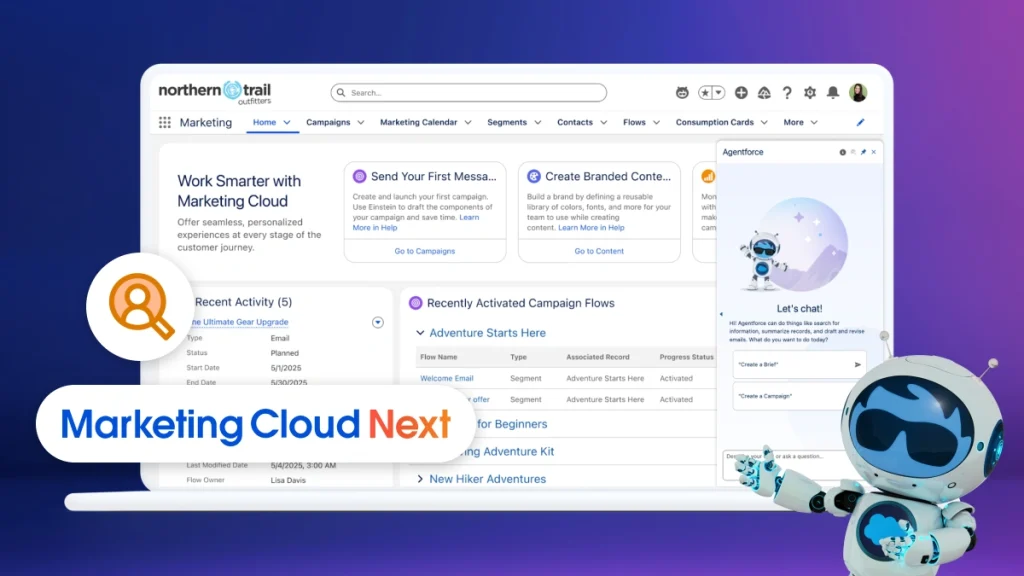
Image Source: Salesforce
Salesforce Marketing Cloud operates at enterprise scale. The platform was originally known as ExactTarget before Salesforce acquired it. It handles both B2B and B2C marketing operations and ranks among the top marketing automation platforms for companies that manage complex, multi-channel campaigns across global markets.
Key Features
Marketing Cloud Connect provides a continuous connection with Salesforce CRM. This enables immediate data synchronization and unified campaign management. Journey Builder arranges automated customer journeys based on immediate behavior and predetermined rules. Automation Studio creates sophisticated, multi-step campaigns. Data Extensions power flexible segmentation by combining contact records with account or event attendance data.
Built-in autonomous AI agents (Agentforce Marketing) make two-way customer conversations easier and optimize paid media, campaign creation, and customized decisioning. The platform delivers triggered emails automatically. It sends time-based messages over days or weeks, behavioral follow-ups when customers show specific interest, and content variation based on recipient priorities. Companies using the platform report a 27% increase in customer engagement and 30% faster campaign execution.
Pros and Cons
Salesforce excels at handling multiple data points from various sources for complex segmentation. The platform scales to accommodate large customer bases and marketing needs. It centralizes email, social media, mobile, and web marketing under one system. But the capabilities come with a steep learning curve that requires proper training. SFMC carries premium pricing. Additional modules like Mobile Studio and Advertising Studio increase costs further. Basic reporting proves limited without investing in the Marketing Intelligence Suite.
Best For Startups
Growth-stage startups with revenue streams benefit most from Salesforce Marketing Cloud. The Starter Suite combines fragmented prospect information and simplifies campaign tracking for founders who identify revenue-generating channels.
Salesforce Pricing
| Lead management, dynamic email marketing, and built-in sales flows | Price | Key Features |
|---|---|---|
| Starter Suite | USD 25.00/user/month | Lead management, dynamic email marketing, built-in sales flows |
| Pro Suite | USD 100.00/user/month | Boosted chat, greater customization, sales forecasting |
| Growth Edition | USD 1,500.00/org/month | Agentforce campaigns, multi-channel journeys, landing pages |
| Advanced Edition | USD 3,250.00/org/month | AI scoring, path experimentation, unified SMS/WhatsApp |
Marketing Cloud Engagement tiers range from Professional (USD 1,250.00/org/month) to Corporate (USD 4,200.00/org/month). Enterprise requires custom quotes.
Apollo.io
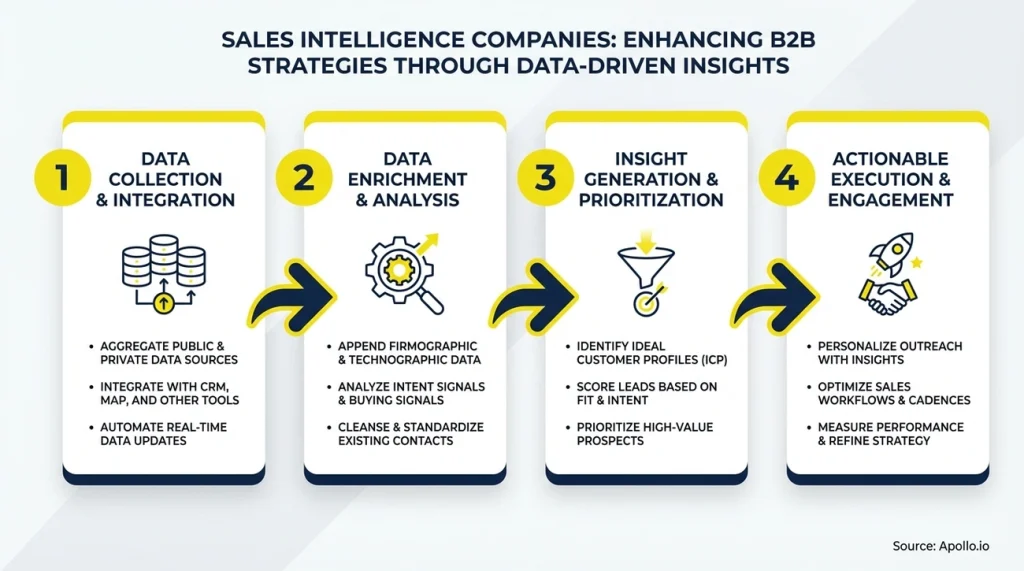
Image Source: Apollo.io
Apollo.io unites sales intelligence, outbound sequencing, and CRM functionality into a unified platform trusted by over 10,000 customers since its 2015 founding. The database has 275 million contacts and 73 million companies, with 97% email accuracy. Startups using Apollo replace 3-5 separate tools and cut costs in half.
Key Features
Contact database access combines with 65+ search filters that include funding stage, technology stack and headcount growth. Signal-based prospecting tracks job changes, funding events and intent signals to optimize outreach timing. Multi-channel sequences automate email, phone, and social workflows in one interface. Both US and international calls get handled by the built-in dialer without requiring separate software. AI capabilities personalize messages based on prospect context. The AI Research Agent drives a 46% increase in meetings booked.
Pros and Cons
Apollo excels at database size and consolidation benefits. Users report saving 100+ hours of manual research for BDR teams. AI-personalized messaging delivers 39% open rates on the platform. Ground data accuracy hovers around 65-70% according to user reviews. Email bounce rates of 15-25% get reported on G2 and Trustpilot. Phone numbers cost 8 credits each versus 1 credit for emails, making cold calling expensive. Credits expire at the billing cycle end with no rollover.
Best For Startups
Early-stage startups with fewer than 20 employees qualify for 50% off Basic or Professional plans for one year. The program has access to the full B2B database, startup-focused webinars and exclusive founder events.
Apollo.io Pricing
| Plan | Price | Annual Credits | Sequences |
|---|---|---|---|
| Free | USD 0.00 | 1,200 | 2 |
| Basic | USD 49.00/user/month | 30,000 | Unlimited |
| Professional | USD 79.00/user/month | 48,000 | Unlimited |
| Organization | USD 119.00/user/month | 72,000 | Unlimited |
Zapier
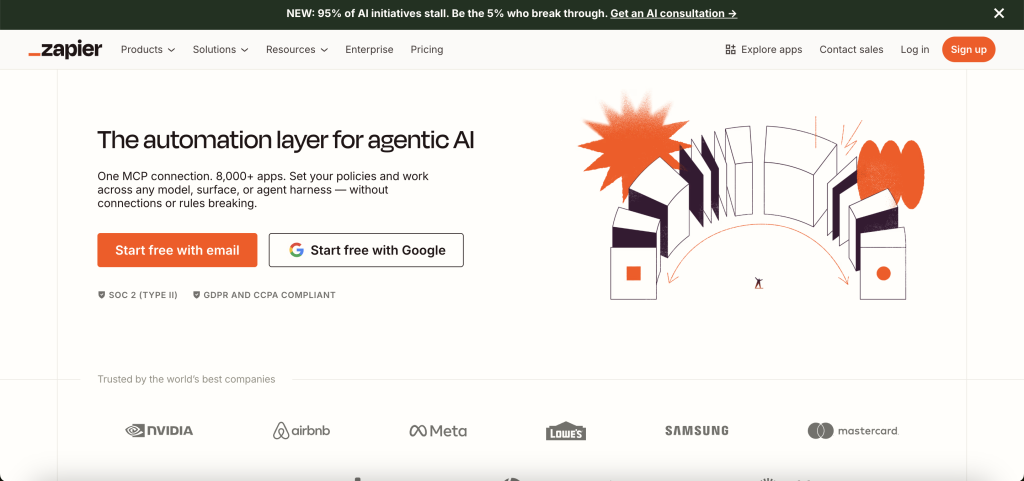
Image Source: Zapier
Zapier functions as the connective tissue between your marketing stack, linking 8,000+ apps through automated workflows called Zaps. The platform is different from dedicated marketing automation software by focusing on cross-app integration rather than campaign management, making it a complementary tool to platforms like HubSpot or ActiveCampaign.
Key Features
Multi-step Zaps create automated sequences across multiple apps without coding. The visual workflow builder has conditional paths, filters, and data formatting. AI Copilot assists with building Zaps and generates code steps while troubleshooting errors. The platform provides 99.9%+ uptime with automatic task replay for failed workflows.
Pros and Cons
Pros:
- Unmatched integration breadth covering every business tool
- Easy-to-use interface requiring zero technical expertise
- Built-in AI features work without API setup
Cons:
- Expensive at high volumes compared to alternatives
- Task-based pricing means multi-step workflows consume multiple tasks per execution
- No mobile app for creating integrations
- Free plan’s 100 tasks/month vanish quickly with actual usage
Best For Startups
Non-technical teams needing to connect apps and automate data flow between existing tools benefit most from Zapier’s plug-and-play simplicity.
Zapier Pricing
| Plan | Price | Tasks/Month | Key Features |
|---|---|---|---|
| Free | USD 0.00 | 100 | Two-step Zaps, 15-min updates |
| Professional | USD 29.99 | 750 | Multi-step Zaps, premium apps |
| Team | USD 69.00 | 2,000 | Unlimited users, 1-min updates |
| Enterprise | Custom | Custom | SSO, advanced permissions |
SALESmanago
Image Source: SALESmanago
SALESmanago positions itself as a European SaaS provider serving mid-market ecommerce businesses with an AI Customer Engagement Platform trusted by over 3,000 companies worldwide. The company started in Kraków, Poland, in 2011. The platform natively combines a Customer Data Platform with marketing automation in a single system and eliminates the friction caused by fragmented tools.
Key Features
The platform centralizes customer data across transactions, website behavior, and priorities within an integrated CDP. AI Sidekick assists marketers in generating content and suggesting segments while constructing workflows. The system delivers omnichannel campaigns across email, SMS, and web push based on behavioral data. Dynamic product recommendations use predictive analytics to boost conversions. Automation workflows trigger based on storefront interactions and purchase history.
Pros and Cons
Pros: GDPR-compliant EU-based infrastructure keeps data within Europe. Time to value averages 30 days with efficient deployment. The workflow engine is flexible with visual design tools. Customer support receives praise for its responsiveness and expertise consistently.
Cons: The learning curve is steep and requires dedicated training. Interface usability is clunky in certain modules. Integration bugs delay campaign deployment occasionally. Pricing may challenge smaller businesses that don’t utilize the full feature set.
Best For Startups
E-commerce startups scaling in multiple regions benefit from SALESmanago’s retention-focused tools and behavioral segmentation. The platform suits teams that coordinate data and messaging without separate systems.
SALESmanago Pricing
SALESmanago offers customized packages rather than fixed tiers. Pricing depends on plan type (Essential, Professional, Enterprise) and contact database size.
Instantly.ai
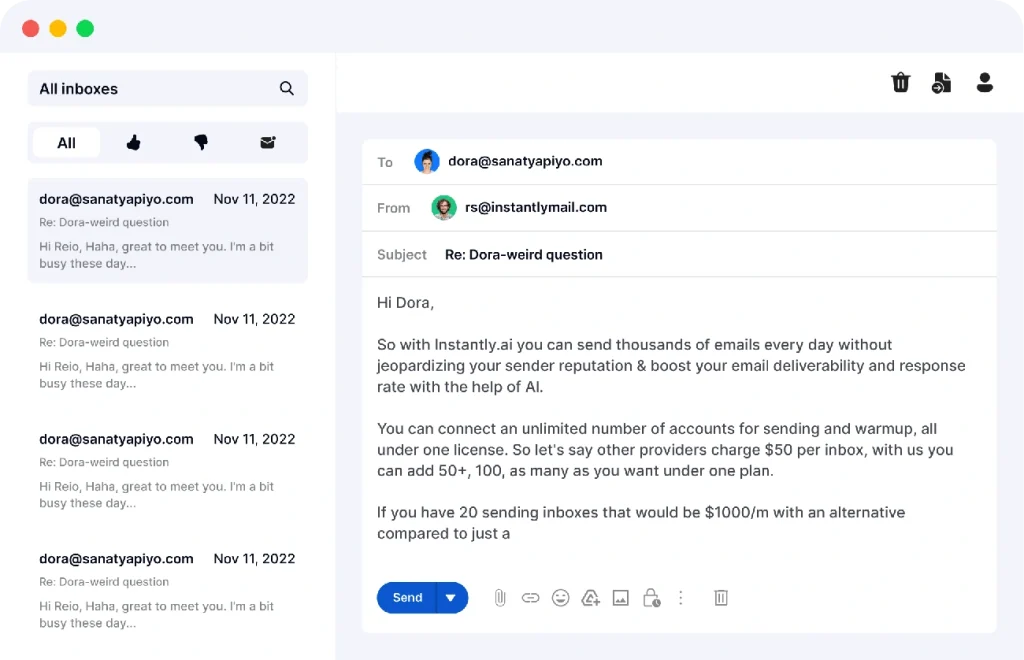
Image Source: Instantly
Instantly.ai targets cold email outreach at scale with a model built around unlimited connected email accounts. The platform was founded by lead generation agency operators and solves the per-mailbox cost problem that plagues high-volume senders. Over 40,000 customers use it to distribute email volume across multiple domains and protect sender reputation through intelligent rotation.
Key Features
The campaign builder creates multi-step sequences with AI-generated copy and spam word checking. Unibox centralizes replies from all connected inboxes into one dashboard for unified response management. SuperSearch provides access to a 450M+ verified contact database with filters for tech stack, company size, and job title. Automated warmup runs across a network of 4.2M+ accounts and builds sender reputation over time. AI Reply Agents handle incoming responses with customizable tone and instructions.
Pros and Cons
Pros: Unlimited email account connections on all paid plans with no per-mailbox fees. Fast setup gets users from signup to sending within hours. The interface is easy to use and praised for its simplicity.
Cons: Deliverability remains inconsistent despite warmup, with users reporting spam folder issues. Modular pricing adds up when combining leads, CRM, and outreach. Email-only focus lacks native LinkedIn or SMS.
Best For Startups
Agencies running 5-50 inboxes benefit most from the unlimited account model. Solo founders needing a quick cold email setup without engineering support find the platform available.
Instantly.ai Pricing
| Plan | Annual Price | Monthly Emails | Contacts | Key Features |
|---|---|---|---|---|
| Growth | USD 37.60/month | 5,000 | 1,000 | Unlimited accounts, warmup |
| Hypergrowth | USD 77.60/month | 100,000 | 25,000 | A/B testing, Unibox |
| Light Speed | USD 286.30/month | 500,000+ | 100,000+ | SISR system, premium support |
SuperSearch (leads) and CRM require separate subscriptions starting at USD 37.90/month and USD 47.00/month.
Common Mistakes Startups Make with Marketing Automation
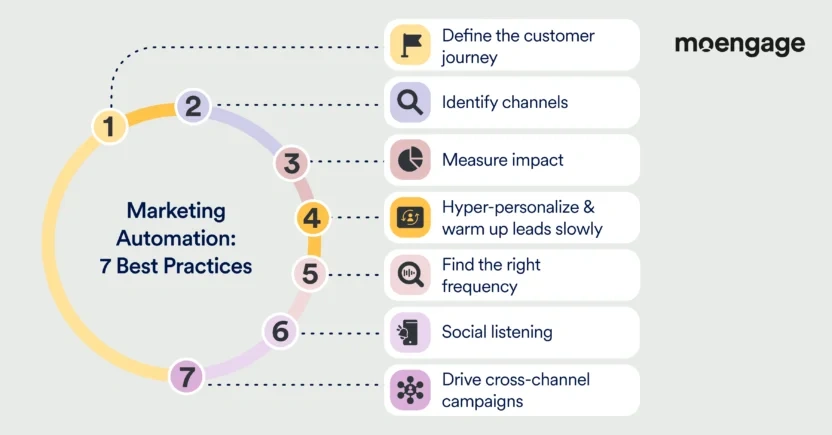
Image Source: MoEngage
Even the top marketing automation softwares fail when implementation lacks foundation. Where startups stumble helps you avoid expensive mistakes that derail growth.
Automating Without Strategy
Automation amplifies whatever direction you provide. 42% of companies abandon their AI initiatives before reaching production without clear objectives, and 70% of digital transformation projects fail to meet goals. Startups often purchase platforms assuming technology solves problems, but 25% of automation initiatives fail because they lack a detailed vision or strategy. Define your target audience, set measurable KPIs, and map customer journeys before you activate workflows.
Ignoring Data Quality
Bad data destroys automation effectiveness. Research shows 77% of organizations rate their data as average, poor, or very poor, with 72% citing lack of time and resources as the main obstacle. Manual data cleansing still consumes teams in 61% of organizations. This creates an unsustainable bottleneck. 89% of data leaders with AI in production experience inaccurate or misleading outputs due to poor data. Regular audits and automated validation prevent these failures.
Over-Complicating Workflows
New workflows for every campaign create unmanageable complexity. Teams mix campaign logic with operational processes and embed data cleanup inside nurture sequences instead of running background hygiene. This fragmentation makes systems brittle and error-prone.
Not Lining Up Sales and Marketing
Misalignment costs companies USD 1.00 trillion in lost productivity each year. While 82% of leaders believe teams are lined up, only 35% of sales and marketing professionals agree. This perception gap stalls revenue.
Conclusion
Choosing the right marketing automation platform can substantially accelerate your startup’s growth trajectory. We’ve covered ten solutions ranging from all-in-one platforms like HubSpot to specialized tools like Instantly.ai for cold outreach. Many offer startup discounts that make enterprise-grade features available to early-stage companies.
The key is matching your specific needs with the right platform. E-commerce startups will find that Klaviyo shines, whereas B2B companies might benefit more from Apollo.io’s sales intelligence. Note that you should avoid common pitfalls like automating without a strategy or ignoring data quality.
Start with the free plans and scale as you grow.