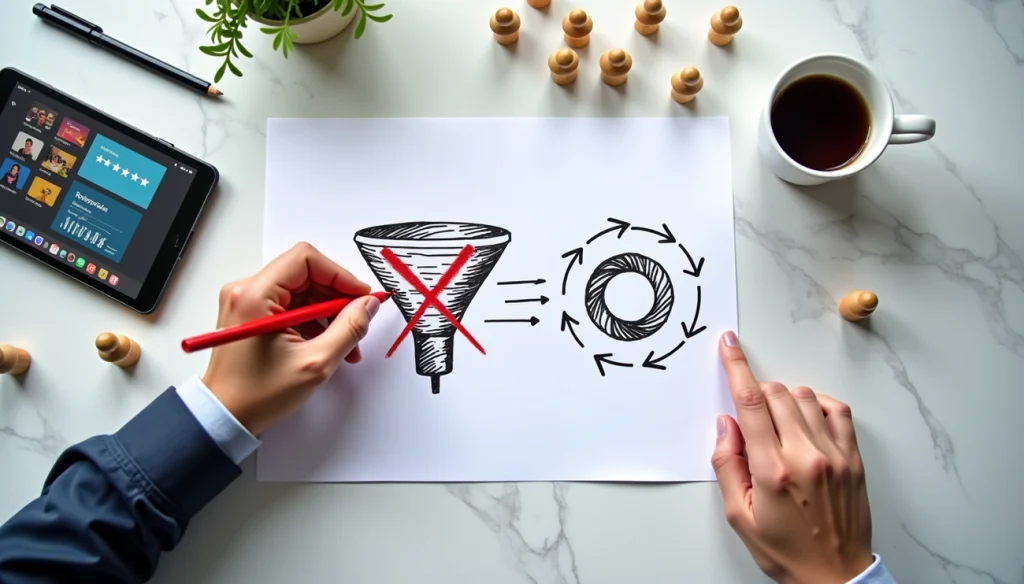
The marketing funnel has guided customer trips for more than a century, but here’s the reality: today’s customers won’t slide neatly down a funnel. Modern buyers bounce across TikTok and reviews, through communities and emails before they ever make a purchase. They interact with brands in non-linear ways that the traditional model simply can’t capture.
Understanding what a marketing funnel is and its stages matters. Clinging to outdated sales and marketing funnel tactics will cost you growth. The funnel ends too early, ignores retention, and fails to account for the advocacy that drives real revenue. We’ll show you why the loop model wins in 2026 and how to implement it in your business.
Understanding marketing funnel stages and the traditional model
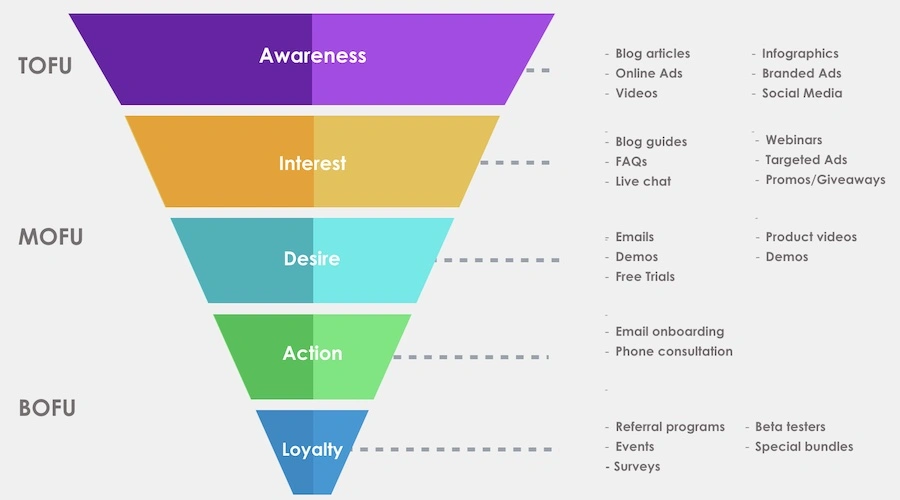
Image Source: Disruptive Advertising
What is a marketing funnel
A marketing funnel maps the complete pathway from the moment someone first finds your brand to the point they become a paying customer. It’s a multi-stage process that tracks potential customers from the moment they learn about your brand to the point where they make a purchase. The funnel metaphor comes from its shape, wide at the top and narrow at the bottom. You’ll also hear it called a sales funnel, lead funnel, or conversion funnel.
The shape serves a purpose. It gathers as many potential leads as possible at the top and then moves those leads through several stages until they become customers. Not everyone moves through all stages, which is why the funnel narrows as prospects drop off at each level.
The three core marketing funnel stages
Most funnels break down into three sections: top of the funnel (TOFU), middle of the funnel (MOFU), and bottom of the funnel (BOFU). TOFU lines up with awareness and part of the interest stage, where potential customers become aware of the brand and begin showing interest. MOFU corresponds to the latter part of interest and the review stage, where prospects review products or services. BOFU represents the conversion stage where prospects make a purchase.
The AIDA model sits at the foundation of most funnels. Elias St. Elmo Lewis conceived AIDA in the 19th century, and it stands for Awareness, Interest, Desire, and Action. Awareness belongs at the top of the funnel, while interest and desire occupy the middle, and action sits at the bottom. This linear approach guides customers from first contact to purchase decision.
How the funnel worked in traditional marketing
The funnel gave a clear path from awareness to action and revealed what companies needed to do to influence consumers at each stage. Marketers relied on linear, predictable steps. You reached people through limited channels: television ads, print media, direct mail, or store experiences. Each stage required different messaging, with top-funnel content focusing on awareness and education while bottom-funnel materials addressed specific objections.
The time the funnel model made sense
Elias St. Elmo Lewis created the funnel in 1898, and the funnel worked because attention was abundant. Drop a direct mail piece through someone’s door, and they’d look at it most likely. The model helped identify where potential customers dropped off and allowed strategies to target gaps. Its biggest benefit was measurability. It showed you where you lost customers to help pivot strategy.
Why the marketing funnel is broken in 2026
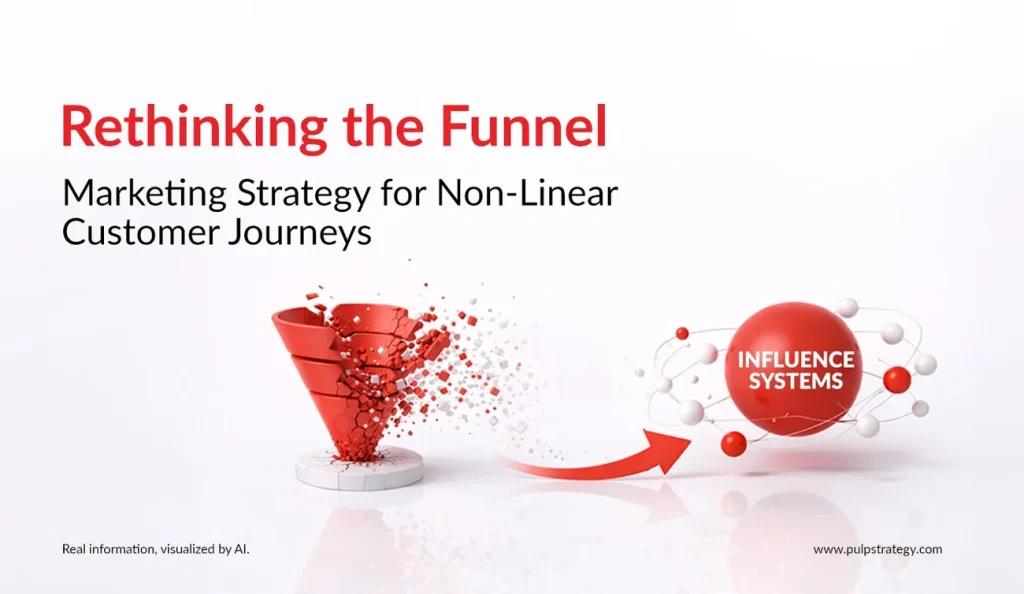
Image Source: Pulp Strategy
Buyers don’t move in straight lines anymore
Customer trips revolve around four overlapping behaviors: streaming, scrolling, searching, and shopping. People switch between these activities rather than following a fixed path. B2B trips stretch across 50 or more interactions and can last 12 to 18 months as different buying committee members participate at various stages. Consumers use an average of 10 different interaction channels when making buying decisions.
They pause their trip, restart it, or change directions based on new information. Someone might add items to cart and get distracted by shipping fees. They come back during a promotion, then abandon again because payday hasn’t arrived yet.
Entry points are everywhere and unpredictable
Customers join and leave the buying cycle at any stage and through many channels. They access on-demand research and peer reviews while receiving individual-specific ads constantly. The sales and marketing funnel assumes a top-down flow, whereas modern buyers enter wherever they want.
Social proof matters more than brand nurture
Reviews now drive decisions more than any brand messaging you create. 92% of consumers read online reviews, and 80% of shoppers trust reviews as much as personal recommendations. Consumer reviews receive 12 times more trust than manufacturer descriptions. Two-thirds of touchpoints during active evaluation involve consumer-driven activities like reviews and word-of-mouth rather than company-controlled marketing.
The funnel ends too early and ignores retention
The traditional marketing funnel focuses solely on acquisition. It neglects the post-purchase phase where loyalty builds. Only 16% of companies focus on customer retention, despite it being five times less expensive than acquiring new customers. Existing customers convert at 60-70% probability.
Attribution is nearly impossible to track
Multi-touch attribution coverage has shrunk to 30-60% of its 2020 signal. Safari cookies expire after one day and make returning visitors appear as new ones. The typical marketing stack has 10-20+ platforms, each with different tracking methodologies.
The loop marketing model and how it works
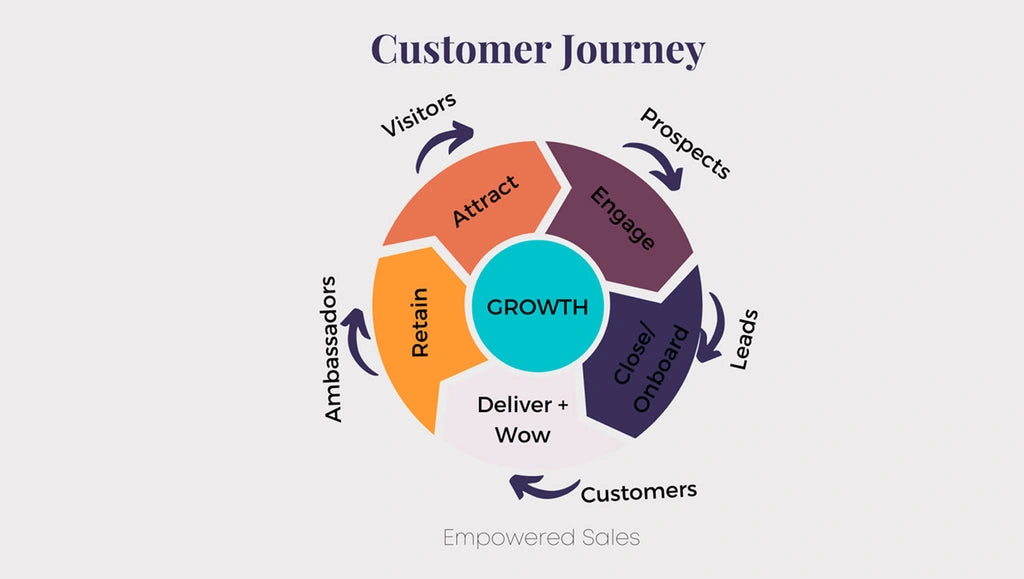
Image Source: TheGenieLab
From linear funnel to circular loop
Loop Marketing replaces the funnel with a continuous cycle where every customer interaction powers the next stage of engagement, retention or expansion. The loop compounds over time and makes each cycle stronger than the last rather than ending at purchase. Marketing, sales and service teams share data and insights across the entire customer’s lifecycle.
Engagement and exploration stages
The loop operates through four stages: Express, Tailor, Amplify and Evolve. Express defines your unique story and brand voice. Tailor uses unified data from CRM, transcripts and web behavior to create tailored experiences. Each stage blends human creativity with AI intelligence.
Action and loyalty in the loop
Amplify ensures you can find it across channels while Evolve tracks performance in real-time. This creates a live feedback loop that uses AI to deliver recommendations. Every campaign makes the next one smarter and creates advantages that compound over time.
How advocacy feeds back into awareness
Customer advocacy promotes an organic growth engine that converts customers into new advocates. Advocates create communities centered around your brand that feel genuine and organic. Through advocacy, prospects convert to customers, who become loyal customers and then advocates themselves.
The flywheel effect of loop marketing
Growth begets growth in a thriving advocate community. The flywheel turns when customer advocates attract and help convert new customers to future brand advocates. Each positive customer experience adds energy to the flywheel and accelerates business growth.
Making the switch: implementing loop marketing in your business
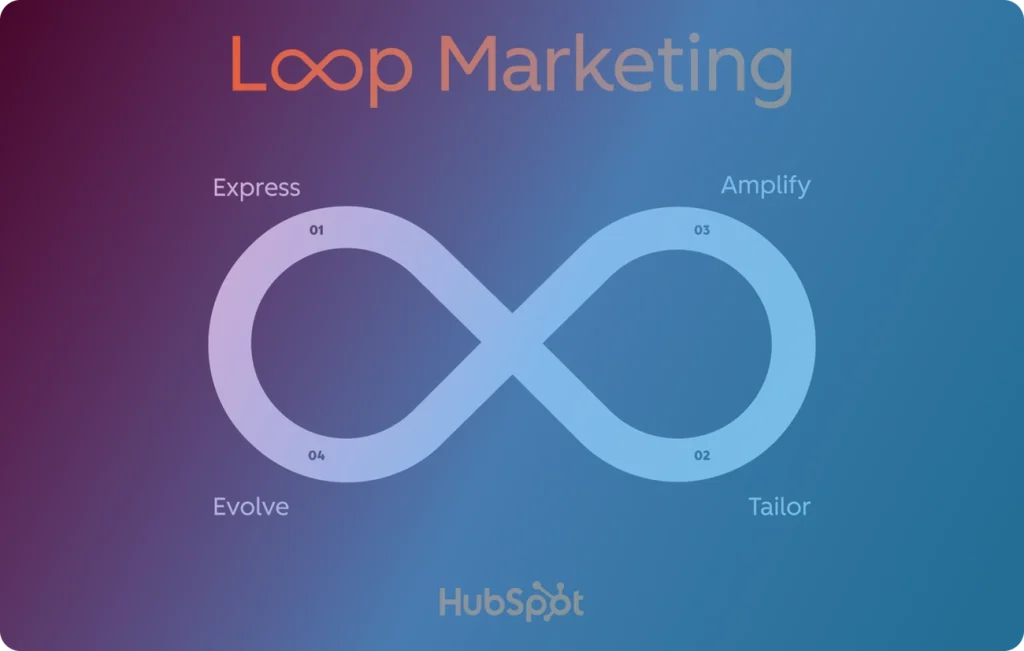
Image Source: Process Pro Consulting
A move from the traditional marketing funnel to a loop model requires measuring different signals and deploying new tactics in your organization.
Start measuring retention and promotion metrics
Track customer retention rate, churn rate, and repeat purchase ratio to understand how well you keep customers participating with time. A 5% increase in customer retention can boost profits by 25% to 95%. Monitor customer lifetime value to measure long-term participation and purchasing behavior. For promotion, measure share rate (the percentage of users sharing content), participating users who share posts on social accounts, and total shares by promoters.
Create campaigns that re-engage past customers
To acquire a new customer costs five to 25 times more than retaining an existing one. Identify inactive customers through participation metrics and CRM systems, then segment them based on churn reasons. Send win-back campaigns with personalized offers that address why they left. 50% of recipients read subsequent emails after a win-back campaign.
Combine PR and marketing for credibility
PR establishes credibility through earned media coverage, which consumers trust more than paid advertising. Your brand secures features in respected publications, and trust translates into higher conversion rates and long-term loyalty. Arrange PR with marketing efforts from the planning stage rather than bringing PR in after launch.
Build community and referral systems
Customer communities where users support one another and provide product feedback are essential. A study of 500 community builders found that 61% of communities improved customer retention. Referral programs use word-of-mouth marketing at lower customer acquisition costs, and referred customers tend to have higher lifetime values.
Test the loop model with one product line first
Start where the pain is greatest in your current funnel. Pick one stage to pilot based on your biggest friction points. Layer in AI tools, measure the effect, and scale what works before expanding to other product lines.
Conclusion
The marketing funnel served its purpose, but customer trips have evolved beyond its linear constraints. Your strategy must adapt to match how people buy today. The loop model prioritizes what drives revenue: retention, advocacy and continuous participation.
Test the loop with one product line first. You should measure retention with acquisition and build referral systems. Your customers become your best growth engine. That’s how you win in 2026.